
When You Need Snow Hauling (And When You Don't)
 Written by Su Diab September 23, 2026 · 5 min read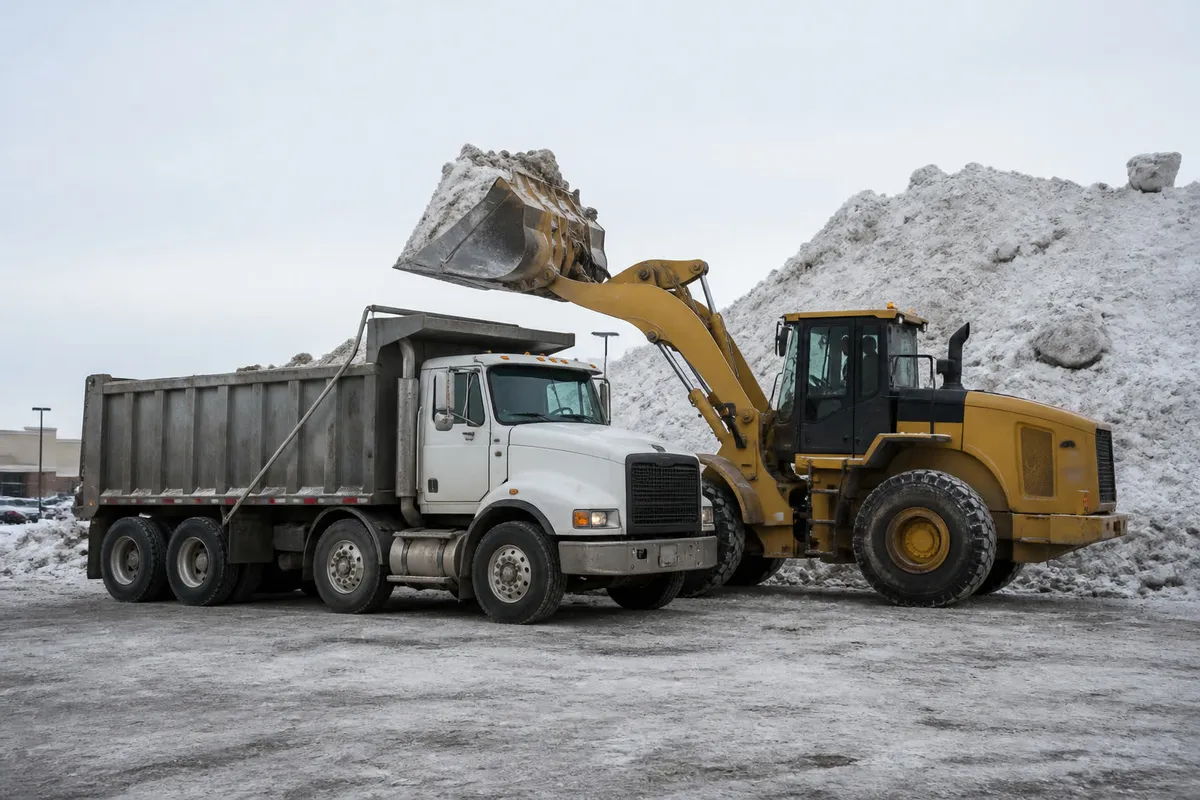
This article is for you if...
- Property managers watching piles eat their parking
- Downtown or tight-site owners with nowhere to push snow
- Anyone quoted for hauling and unsure if it is necessary
Quick Answer
You need hauling when there is nowhere left to put the snow: piles taking parking stalls, blocking sightlines, or a site with no perimeter to push snow onto. It is rarely needed on residential properties. Agree the trigger and rate before the season, because booking it in February costs the most.
Most snow work is about moving snow from where it landed to somewhere else on the property. Hauling is different: the snow leaves entirely, loaded into trucks and taken off site.
It costs considerably more, and it is genuinely necessary less often than it gets quoted. Here is how to tell.
When you actually need it
Your piles are taking parking you need. This is the most common real reason. Every stall occupied by a snow bank is a customer who cannot park or a tenant complaint. By midwinter, a lot cleared six or seven times can lose a meaningful share of its capacity.
Piles block sightlines. A bank at the corner of an entrance that stops drivers seeing oncoming traffic is a safety problem, not an aesthetic one.
The site has no perimeter. Downtown buildings, tight retail plazas and some condo complexes have no lawn or margin. Every clearing pass has to end with the snow going somewhere, and if there is nowhere, it goes on a truck.
Piles are too tall to stack further. Once a loader is stacking rather than pushing, and the pile is at the limit of what it can reach, hauling is the only remaining option.
Meltwater from piles is causing problems. A large pile uphill of a walkway or entrance produces runoff that refreezes across it every chinook. Sometimes moving the pile fixes it; sometimes the pile has to go.
When you do not need it
Almost any residential property. A standard driveway has a lawn or an edge. Piling snow there is normal, and hauling would be an unusual expense for a home.
Sites with genuine perimeter space. If there is somewhere to push snow that is not costing you parking and not uphill of a walkway, use it.
Early in the season. Hauling in December on a lot that has only been cleared twice usually means someone chose the wrong storage location, not that the site needs hauling.
If a contractor proposes hauling in the first month of the season, ask where snow is being stacked and why that is not working. Sometimes the answer is legitimate. Sometimes it means the storage plan was not thought through.
What drives the cost
Hauling is a separate operation, which is why it is priced separately:
A loader to gather and load the piles, which is heavier equipment than plowing needs.
Trucks, often several, and the cycle time between your site and the dump location.
A legal disposal site. Snow from a commercial lot carries road grit, salt and vehicle contaminants, so it cannot simply be dumped anywhere.
Time. Loading and hauling a large accumulation is measured in hours or a full shift, not the minutes a clearing pass takes.
The practical implication: hauling cost scales with volume and distance, not with how quickly you need it done. A site with a long haul to a disposal location costs more than one nearby, regardless of pile size.
Agree it before the season
This is the actionable part.
If your property is likely to need hauling at some point in the winter, negotiate it into the contract in autumn:
- The trigger. At what point does hauling happen? “When piles exceed X” or “when we lose more than Y stalls” is better than leaving it to a phone call.
- The rate. Agreed in advance, in writing.
- The notice period. How much warning do you get, and how much do you need to give?
- Where snow is stacked in the meantime, since good storage placement delays the need for hauling considerably.
Booking hauling as an emergency in February is when it costs the most, takes the longest to schedule, and gives you the least negotiating room. Every other property in the city is in the same position at the same time.
The storage decision that delays hauling
The best way to reduce hauling cost is to need it later, and that comes down to where piles go from the first clearing of the season.
Good storage placement:
- Uses areas that do not cost you parking
- Sits downhill of walkways and entrances, so meltwater runs away rather than across them
- Avoids storm drains entirely
- Keeps sightlines at entrances and exits clear
- Consolidates rather than spreading piles across the lot
That decision gets made in November and determines whether you are hauling in January or March.
Frequently asked questions
What is snow hauling? Loading accumulated snow into trucks and removing it from the property entirely, rather than pushing it into piles on site.
Do I need snow hauling for my driveway? Almost certainly not. Residential properties normally have somewhere to pile snow.
Why is hauling so expensive? It requires a loader, multiple trucks, cycle time to a legal disposal site, and hours rather than minutes of work.
When should I arrange it? Before the season, with the trigger and rate agreed in the contract. February booking is the most expensive and hardest to schedule.
How can I avoid needing it? Good snow storage placement from the first clearing, using space that does not cost parking and does not drain across walkways.
Getting it in the contract
Our commercial snow removal quotes cover snow storage locations and hauling terms up front, so the decision is made in autumn rather than during a February capacity crisis. Response times are written into each contract rather than quoted as one number for every property.
For residential properties, residential snow removal plans handle storage as part of normal clearing, and hauling is rarely required.
Su Diab
Owner, Golden Angel Snow Removal
- Running Calgary snow removal crews since 2021
- 10 years experience in landscaping
- Licensed, insured and WCB covered
Su has run snow removal crews in Calgary since 2021, following ten years in the landscaping industry. He works on the properties himself and sets the standard the crews work to.