
Ice Control vs Snow Clearing: Why Calgary Needs Both
 Written by Su Diab September 24, 2026 · 5 min read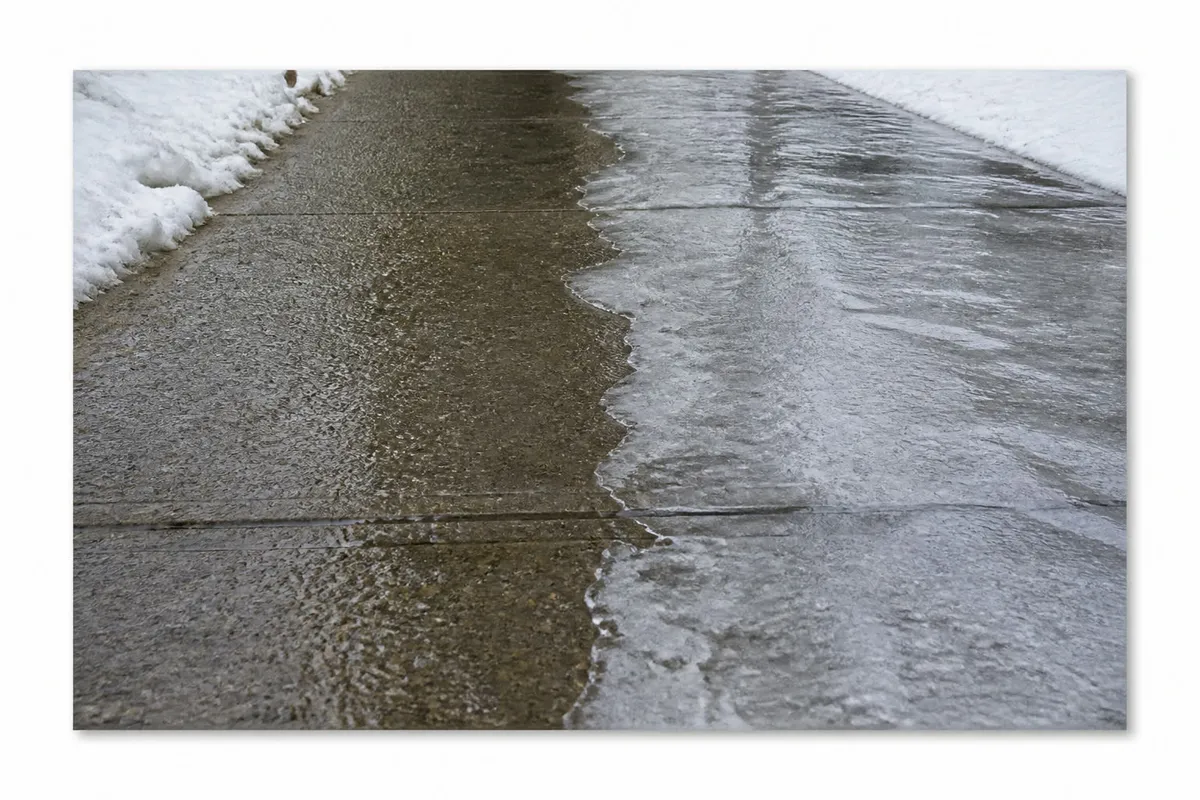
This article is for you if...
- Property owners whose lot was plowed and still had a fall
- Anyone comparing a cheap quote against a full-service one
- Managers reviewing what their contract actually covers
Quick Answer
Snow clearing removes snow from a surface. Ice control prevents or treats the ice that forms afterwards, usually from meltwater refreezing. In Calgary's chinook climate the ice typically arrives after the clearing visit has finished, so a clearing-only arrangement leaves the highest-risk mornings uncovered.
If you take one thing from everything written about Calgary winter maintenance, make it this: clearing snow and controlling ice are two different jobs, and here you need both.
Most disappointing snow removal experiences in this city trace back to buying only the first.
The difference
Snow clearing is mechanical. A plow, blower or shovel moves snow off a surface to somewhere else. It deals with what fell.
Ice control is chemical and preventive. Salt, ice melt or sand applied to stop ice bonding to the surface, or to treat it once formed. It deals with what happens next.
The distinction matters because in Calgary, the hazard usually arrives after the clearing is finished.
The sequence that catches everyone
Here is the pattern that produces most winter falls here:
- Snow falls overnight
- A crew clears it properly in the morning. The surface is bare. The job is done well.
- During the day a chinook pushes the temperature above freezing
- Residual snow, roof melt and snow piles produce water that runs across the cleared surface
- Overnight the temperature drops back below zero
- That water refreezes as a thin, smooth, often transparent layer
- At 7am somebody steps on it
At no point did the clearing fail. The surface was cleared. The hazard was created afterwards, by water, on the surface that had been cleared.
This is why “we plowed the lot” and “the property is safe” are different statements in Calgary in a way they are not in cities with a stable frozen season.
Why refrozen ice is worse than snow
It is hard to see. Thin clear ice on dark asphalt looks wet. People adjust their walking for visible snow. They do not adjust for something invisible.
It is smoother. Packed snow has texture. Refrozen meltwater is flat.
It forms overnight. So it is waiting at opening time, exactly when foot traffic peaks and nobody has inspected the property yet.
Nobody expects it. The last weather event was two days ago and it was cleared. Mentally, winter maintenance feels finished.
The bylaw counts ice
Calgary’s requirement for the public sidewalk bordering a property is bare surface within 24 hours of snowfall ending.
Not “cleared of snow”. Bare surface. Ice does not meet that standard.
So a property can be fully compliant at 4pm and non compliant by 7am without any new snowfall. Fines escalate at $250, then $500, then $750 within a twelve month period, plus a minimum $150 plus GST if the City clears it.
What good ice control looks like
Timing beats quantity. Applying product before an overnight freeze prevents ice bonding to the surface. Applying it to formed ice the next morning works, but slower and with far more product.
The right product for the temperature. Rock salt loses effectiveness below roughly minus 10C, which Calgary passes routinely. Calcium chloride works far colder. Sand melts nothing but gives immediate traction at any temperature. A crew using only rock salt in a cold snap is applying something that will largely sit there.
Priority on walking surfaces. Entrances, walkways, steps and accessible routes matter more than the middle of a parking lot, because that is where people are on foot.
Repeat visits triggered by conditions, not just snowfall. This is the clause most contracts miss. If ice control only happens when snow falls, freeze and thaw mornings get nothing.
The question that tests any contract
Ask a prospective contractor this:
“A chinook melts snow on Tuesday, it refreezes Tuesday night, and Wednesday morning the lot is icy. No new snow has fallen. What happens?”
The answers you might get:
- “We come out and treat it, that’s included.” Good.
- “We can come out, it’s billed as an additional application.” Acceptable, as long as you know the rate and it happens automatically rather than waiting for you to notice.
- “We come out when it snows.” That is a clearing contract, and Calgary’s most common hazard is not covered.
What it costs versus what it prevents
Ice control adds to the price of a snow contract. It is worth being clear-eyed about the comparison.
Against that cost:
- A slip and fall claim, which routinely exceeds a season of full-service maintenance
- Bylaw fines that escalate to $750
- The reputational cost for a business whose entrance sends someone to hospital
- For residential owners, the personal risk to family and visitors
The cheapest quote is usually cheapest because it excludes exactly the thing that produces those outcomes.
Frequently asked questions
What is the difference between snow clearing and ice control? Clearing moves snow off a surface. Ice control prevents or treats ice, usually from meltwater refreezing after clearing.
Why does Calgary need both? Chinook freeze and thaw cycles create ice after clearing has finished, so a clearing-only service leaves the most dangerous mornings uncovered.
Does the bylaw count ice? Yes. The standard for public sidewalks is bare surface, which ice does not meet.
Should ice melt be applied before or after freezing? Before, where possible. It prevents ice bonding and uses less product than treating formed ice.
How do I tell if a contract covers this? Ask what happens after a freeze and thaw with no new snowfall. If the answer is that they come when it snows, ice is not covered.
How we handle it
Ice control is part of our service rather than a separate line, in both residential snow removal and commercial snow removal, specifically because of the cycle described above.
Clearing snow and leaving the ice is half a job in this city, and it is the half that does not cause falls.
Su Diab
Owner, Golden Angel Snow Removal
- Running Calgary snow removal crews since 2021
- 10 years experience in landscaping
- Licensed, insured and WCB covered
Su has run snow removal crews in Calgary since 2021, following ten years in the landscaping industry. He works on the properties himself and sets the standard the crews work to.